The emergence of a new design space.
Most technologies for working at very small scales fall into familiar buckets: mechanical tools, chemical treatments, or engineered biology optimized for one narrow function. Biobots may open a different path: systems that combine embodiment, sensing, movement, and response in one tiny package. Potential capability areas include:
- Sensing: detecting gradients or conditions in an environment
- Navigation: moving through fluid or other complex surroundings
- Signal amplification: turning small local signals into larger, more detectable ones
- Payload delivery: carrying or releasing useful materials at a target
- Sequestration or transformation: interacting with unwanted targets in ways conventional systems cannot easily do
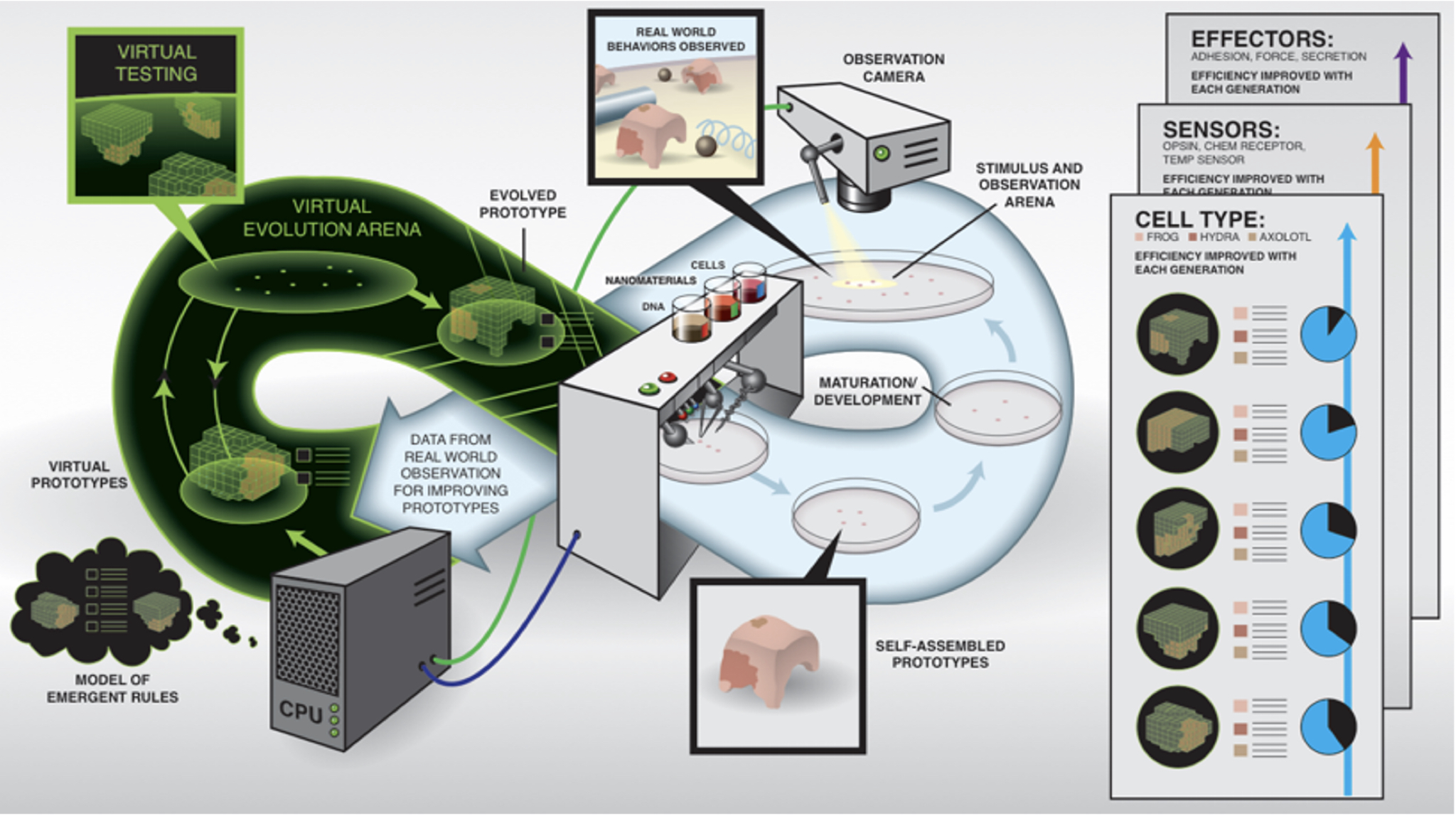
Designing and building a biobot.
- AI-driven design: A specialized large language model hypothesizes millions of potential configurations that might meet a given set of requirements, generating digital twins of each configuration and its resulting behaviors.
- Prototype assembly: Target body configurations are assembled in a wet lab according to the architecture of the most promising digital twins.
- Fitness evaluation: The capabilities of each configuration are tested against the original requirements.
- Error correction: Promising models are optimized and refined; less promising configurations are discarded.
- Iteration: The process repeats until the desired capabilities are achieved.